


The Contemporary Condition.
This book I feel speaks into a notion of type of change. Change is a necessary, it’s an unstoppable inevitablity, but what is changed is not, nor how we come to somewhere else, this is not directed. The route is not written. Yet today the future very much feels inevitable as though the iron rolling stock is in momentum and on a track we are upon. We are but the passengers of.
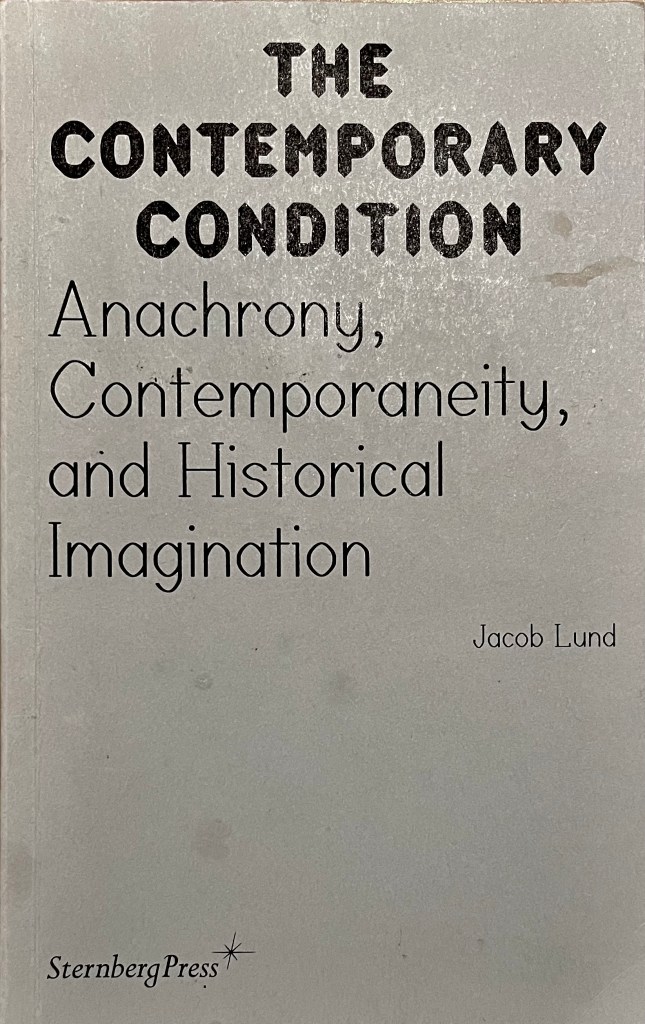
I think this paragraph sums up this essay by Jacob Lund.
“The anachronic intertwinement of heterogeneous temporalities should therefore not only be thought vertically, as connections between past, present, and future within one singular unified history (most offen the Western one), but also horizontally as the interconnection of different vertical histories in the same present. The anachronic approach itself is practiced under specific historical conditions, and today these conditions are characterized by a global contemporaneity, constituted by the coming together of different times in the same historical present. A historical understanding of anachrony and how it challenges a linear, chronological, and unified understanding of history therefore has to take contemporaneity as a new historical condition and idea into consideration”.
The way I understand what he is saying here is that we live within a certain inertia. Our experience of time is like that of being on a train. We pass quickly through the (horizontal) landscape of history. As we move we are constantly being update with our history, of culture contemporaneous to our own. The carriage we ride is a wonder room of curiosities. The change we experience is that of an object in a state of motion. The change is that of the future that “is to be”. Not that of the avenir, of the “yet to come”. It is as though we are the curators of a slideshow and the next slide is only to be selected.

